The popularity of online media has led many businesses to market their products using networking platforms. From creating Instagram accounts for their business to promoting their products through Facebook ads, industry professionals are making the most of the tools available to improve their online presence. Yet, while the effective use of such features can greatly improve sales and engagement, a poor approach to these strategies can create a pretty damning social media firestorm for the company at hand.
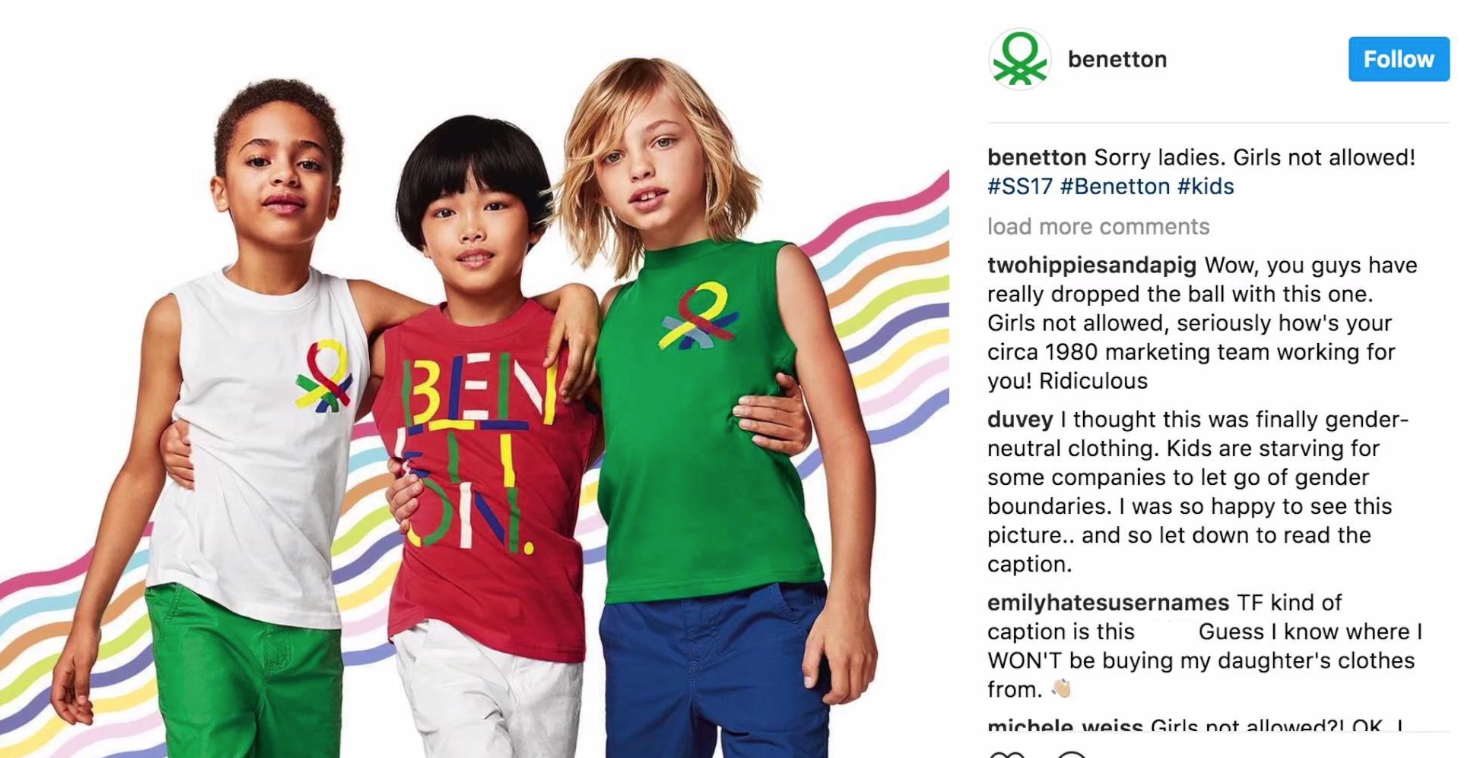
Popular clothing brand Benetton know this all too well after finding themselves amidst a fail in 2017 when they shared a picture on Instagram of three boys in what appear to be gender-neutral clothing with the caption “Sorry ladies. Girls not allowed!” (refer to image 1 below). Users of the platform were outraged at the post, not only because the caption is implicitly sexist in nature, but because the brand prides itself on being diverse and inclusive, without the boundaries of gender. While Benetton later apologised in the comment section of the post, stating their intention was to be ‘playful’, a social media fail arises because this post does not match the values that Benetton has long strived to promote.
Since the days of their ethically-diverse campaigns that spanned from the 1980’s to 2000’s, Benetton has long preached inclusivity and social consciousness. Following the worldwide success of their ‘United Colours’ campaign, a unique sense of acceptance and freedom was associated with the brand which has largely contributed to their global popularity (AdAge, 2003). Their website follows this lead by stocking gender-neutral clothing, along with clothing aimed at females and males that are equally priced despite differences in types and sizes of material in a bid to maintain equality (Fuller, 2017). This has brought great traffic to the brand, particularly as more parents are now moving away from the pink and blue gendered-stereotypes and are allowing their children to decide what they like for themselves (Levinson-King, 2018). With the social issue surrounding gender-conformity so significant in this day and age, much of Benetton’s Instagram audience are likely to resonate with their call for inclusivity and appropriation.
A networked public has been described by Boyd (2010) at p39 as “the imagined collective that emerges as a result of the intersection of people, technology, and practice”. In his work, he discusses in depth how these online publics act as a community where people who share collective interests can gather for social, cultural and civic purposes. Benetton were able to use this affordance to their advantage by facilitating a networked public of their own through their Instagram account, which was filled with like-minded people who agreed with Benetton’s ‘ahead of the time’ campaigns. Persistence is a major aspect behind the formation of their networked public as Benetton have introduced countless ad campaigns that, while maybe little risky, have been memorable and exciting moments that have stuck around in the minds of many (refer to images 2 and 3 below). Therefore, while the term “Girls not allowed!” may be a harmless phrase spoken between boys in the schoolyard, Benetton should have better considered what their particular public would take from the words. This was the first key factor behind the social media failure.
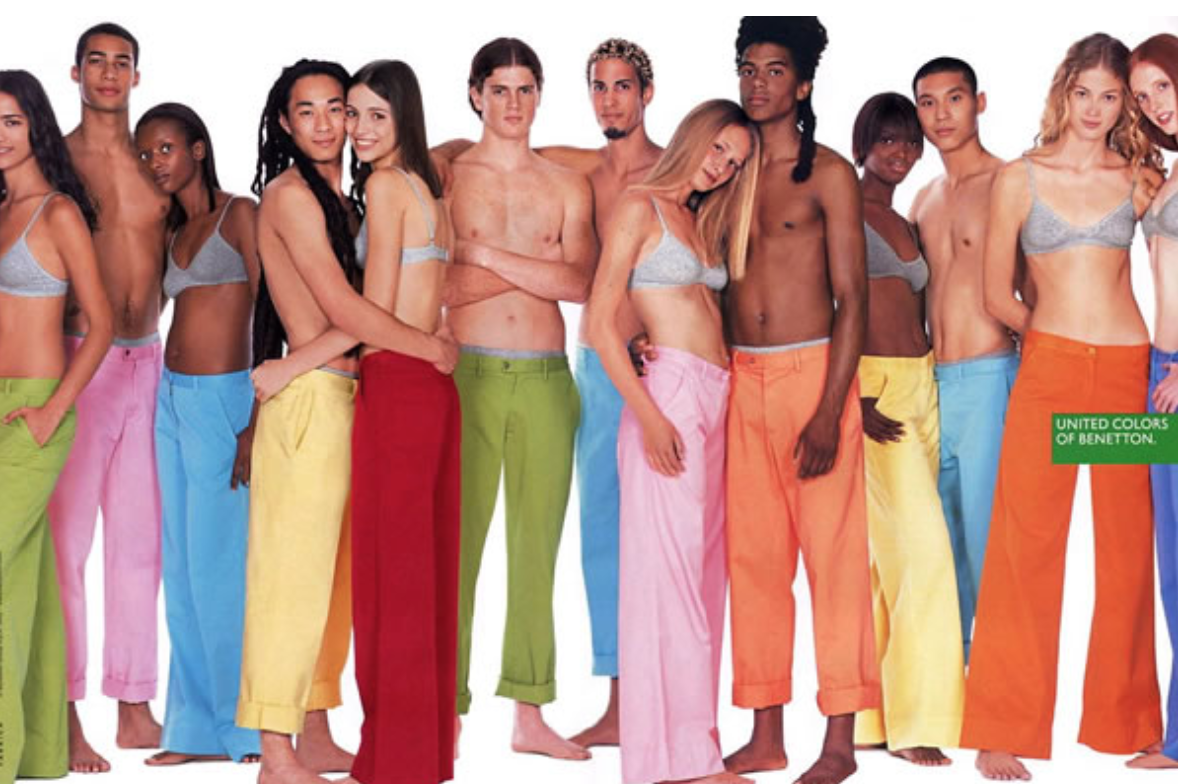
Image 2: Benetton’s ‘United Colours’ campaign 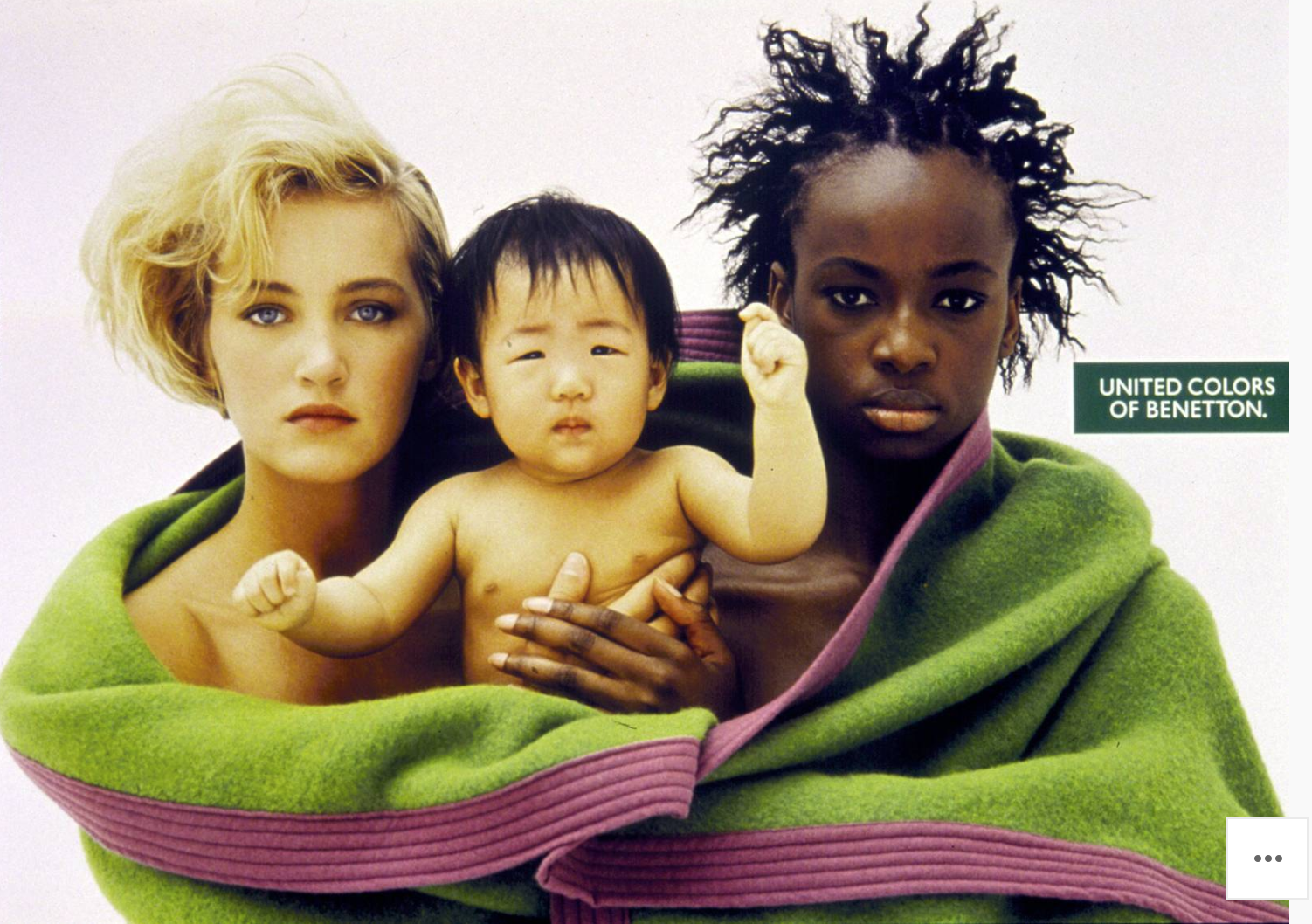
Image 3: Benetton’s ‘United Colours’ campaign
The cultural context behind the post is another factor to why this social media post was a fail. As Sharon Lamb, a psychologist at the University of Massachusetts stated, brands must be careful with the messages they share to their audiences, particularly as women and girls have a history of being excluded from male-oriented categories. When speaking on the Benetton issue, she said that “while the caption is likely a joke, society is just not there yet…it’s only a joke if everyone can participate in its humour” (Sole, 2017). The way that consumers react to the content posted by businesses such as Benetton can seriously damage the brand’s image. Not only does being associated with sexism decrease the brand’s chances of positive spreadability or searchability, but it also can influence their invisible audiences, such as the large-scale companies that carry their label and/or their in-store shoppers.
In addition to this, we truly do now live in a world where media is all around us, or in a ‘mediapolis‘, which is described by Deuze (2011, p.137) as a “comprehensively mediated public space where media underpins and overarches the experiences and expressions of everyday life.” When a post is made online, it’s therefore all too easy for it to be scrutinised, screen-shotted and reposted, with some social media fails going viral within just a few short hours. This cycle is only made easier with the affordances of platforms such as Facebook and Instagram which offer users the option to comment on pictures and tag their friends, which is great for increasing engagement, but can make a bad social media fail even worse. Joining in the negativity in a comment section of a photo is now more common than ever, with Instagram, twitter and other major networking sites allowing users to hide behind usernames and pseudonyms that act as a cover (White, n.d).
Unfortunately, Benetton also suffered from an ineffective response and crisis management strategy which further contributed to the social media fail. While Benetton did issue an apology statement following the incident stating that their intention was only to be ‘playful’ (refer to image 4 below), some followers were unhappy with the brand’s lack of accountability in the message. One user commented “I would be more impressed with your apology if you acknowledged that you were wrong.. and then added a disclaimer writing how inappropriate and sexist [the post] is” (Fuller, 2017).
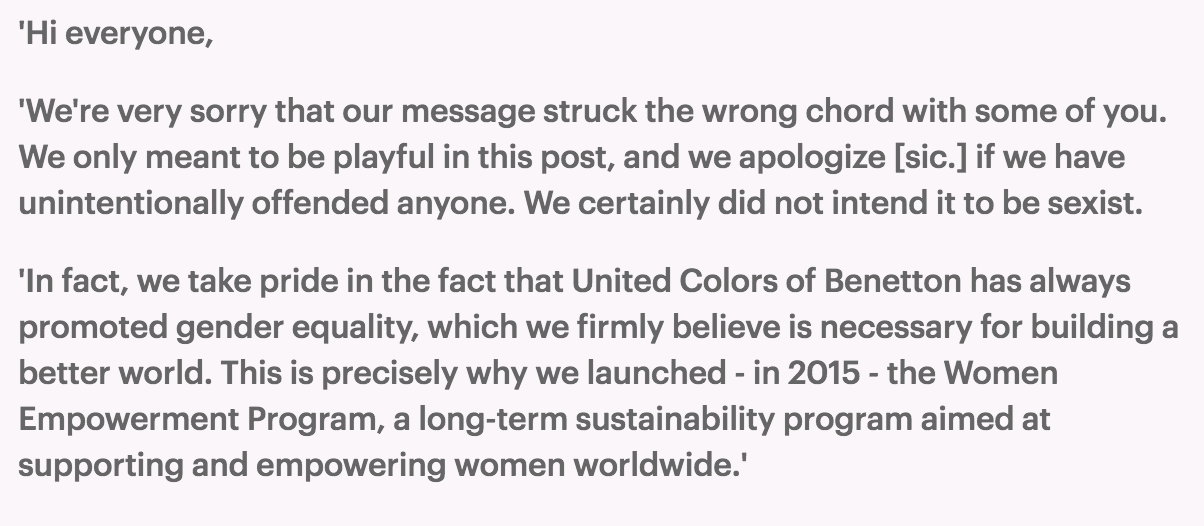
One of the most important aspects to crisis management is to acknowledge the issue, be transparent and identify how to do better in the future. Benetton was polite in their apology to their audience, however they didn’t explicitly take fault for the incident which lead to some disappointment from their audience (Blott, 2017). The caption of the post also wasn’t changed until the post was deleted a few weeks after the incident, meaning that the brand faced more backlash than was necessary. Nevertheless, in the aftermath of this failure, the brand has been careful to only upload content to Instagram that matches their brand statement. Two examples of these posts can be seen in image 5 and 6 below.
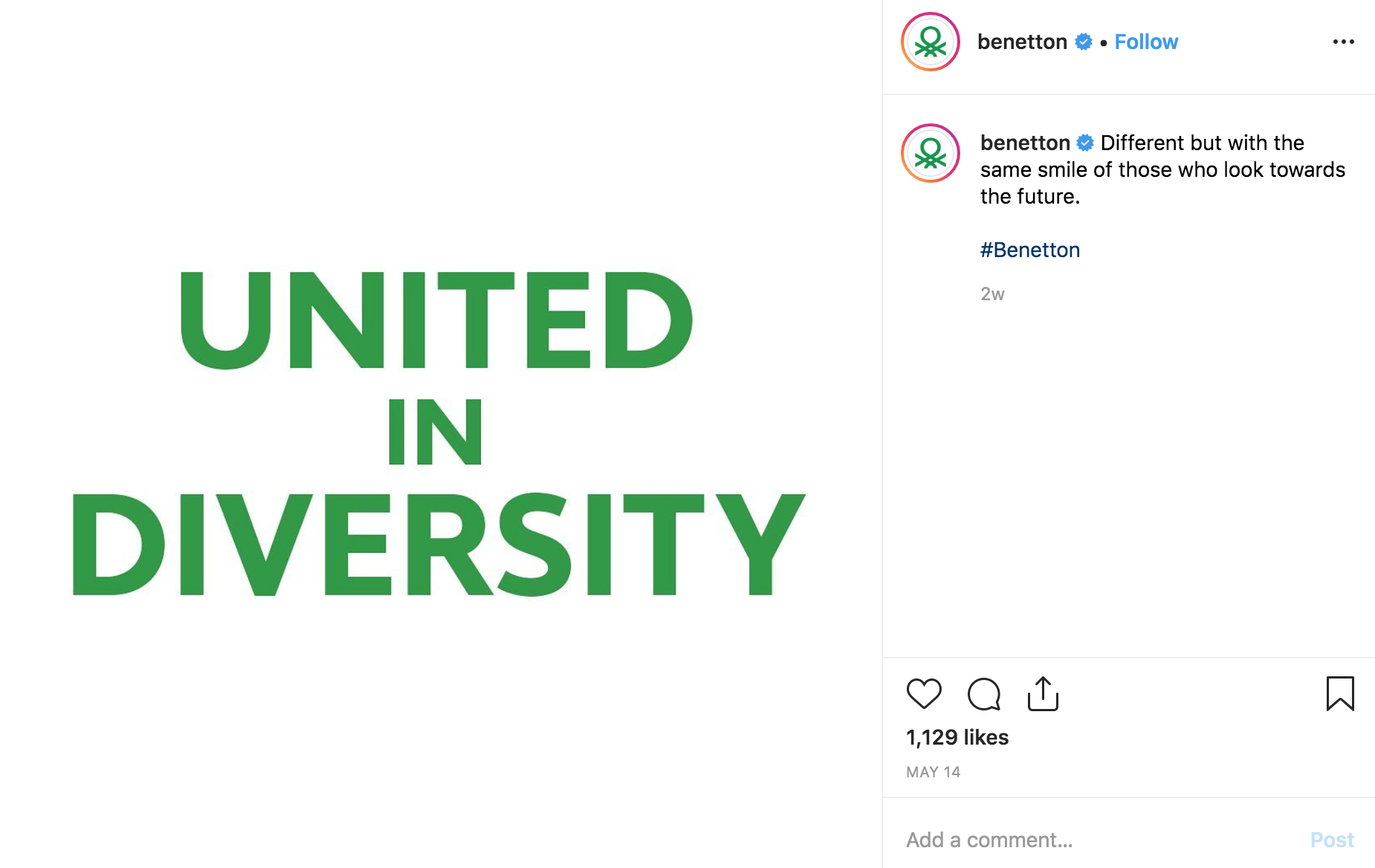
Image 5: @benetton via Instagram 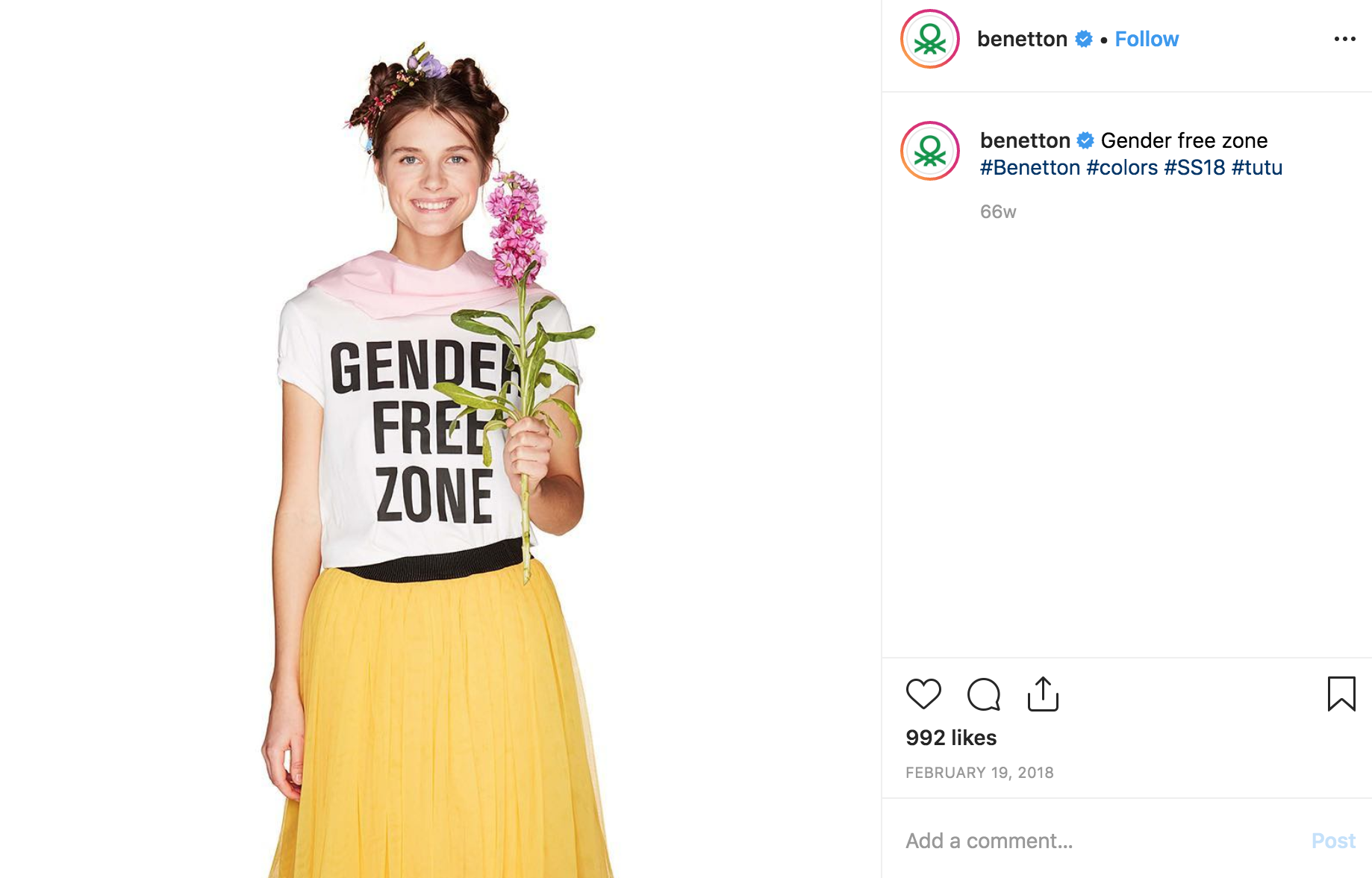
Image 6: @benetton via Instagram
There are a number of ways to avoid this kind of incident, but overall it’s fair to say that Benetton’s social media strategy should have better considered the values of their target audience. If more thought was put into the way that the audience would interpret that caption, this fail could have been avoided altogether. This comes back to knowing your public and doing your research. Having all posts checked and approved in advance would also be a great way to ensure that social media fails such as this one don’t happen. If I was the social media manager for this brand, I would create a content calendar, complete with post dates, times, captions and images, that I could share with my team to ensure that each piece of content represents both the brand’s values and those of the audience. As gender-conformity is a heated social issue in today’s society, I would also endeavour to post uplifting, positive and respectful content in order to create a safe space for people who are interested in the topic.
In essence, it’s clear that social media has the power to make or break a brand. Mistakes and fails are easier than ever to spot with today’s social networking sites, however with a smart social media strategy and an effective research plan, Benetton will be able to build their following to even greater heights whilst staying true to their core values of inclusivity and diversity.
References
Fuller, G. (2017). United Colors of Benetton Under Fire For ‘Sexist, Outdated’ Instagram Post. Retrieved from https://www.allure.com/story/benetton-sexist-kids-ad
Adage. (2003). Benetton. Retrieved from https://adage.com/article/adage-encyclopedia/benetton/98948
Greaves, K. (2017). United Colours Of Benetton Saying ‘Girls Not Allowed’ Has People Pissed. Retrieved from https://www.huffingtonpost.ca/2017/06/07/united-colours-of-benetton-instagram_n_16987858.html
Sole, E. (2017). Benetton’s ‘Girls Not Allowed’ Instagram Sparks Outrage. Retrieved from https://www.yahoo.com/lifestyle/benettons-girls-not-allowed-instagram-sparks-outrage-213041303.html
King, L. (2018). Children’s toys: The backlash against pink and blue branding. Retrieved from https://www.bbc.com/news/world-us-canada-46613032
Deuze, M. (2010). Media Life. Retrieved from https://scholarworks.iu.edu/dspace/bitstream/handle/2022/3764/DeuzeBlankSpeers%20MLv1.pdf
White, T. (n.d). Pen Names in Social Marketing. Retrieved from https://smallbusiness.chron.com/pen-names-social-marketing-67381.html
Blott, U. (2017). Shame on you!’ Benetton is forced to apologise after using ‘girls not allowed’ to promote its children’s clothing (but some are bemused by the backlash). Retrieved from https://www.dailymail.co.uk/femail/article-4580146/Benetton-forced-apologise-sexist-advert.html
Boyd, D. 2010. “Social Network Sites as Networked Publics: Affordances, Dynamics, and Implications.” In Networked Self: Identity, Community, and Culture on Social Network Sites (ed. Zizi Papacharissi), pp. 39-58. New York: Routledge.
 KCB206: Assignment 3